


 Destination
 Verified
The khors around Khasab are rias, river valleys that flooded as the land under them sank. GEO ExPro, the geoscience magazine, puts that subsidence at about 6 mm a year: the Eurasian plate is overriding the Arabian plate, and the northern edge of Arabia bends downward under the load. A Norwegian fjord is carved by ice and then flooded. A Musandam khor was carved by water running off the Hajar range and then flooded.
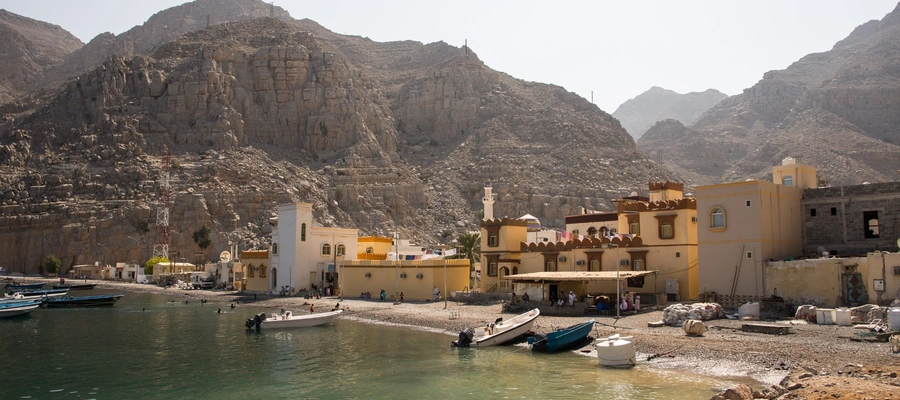
From a boat the two look alike. Cliffs drop straight into deep water, the channels turn corners so the open sea disappears behind you, and each fishing village sits on the only flat ground at the foot of a slope. The differences are in the detail. The walls are pale limestone with scrub and acacia on the upper slopes rather than pine, the water is warm enough to snorkel in for most of the year, and the light at midday is hard and white rather than soft. The scale is smaller than Norway and the colour is different; the feeling of being enclosed by rock on both sides is the same.
Khor Sham, mapped in British charts as Elphinstone Inlet, is the khor our supplier's dhows work every day from Khasab harbour. The full day Khor Sham cruise runs from 10:00 to 16:00 with lunch on board. If you are already staying in Khasab, the three-hour version leaves at 10:00 or 13:30. Dolphins are most often seen at the entrance of the khor, and the dhow anchors near Telegraph Island and Seebi Island for swimming and snorkelling.
Telegraph Island, Jazirat al Maqlab in Arabic, held a British repeater station for the Persian Gulf telegraph cable. It opened in 1864 and was abandoned in December 1868, when the cable was rerouted to Henjam and Jask. The stone foundations are still there and you can see them from the anchorage. Guides like to say the posting gave English the phrase "going round the bend", from the voyage round the Strait back to India. It is a good story, but there is no documentary evidence for it.
To see the khor after the day boats leave, the overnight dhow cruise anchors in a bay inside Khor Sham with a barbecue dinner on deck. If you would rather sleep on land, the beach camp is reached by speedboat and has no road access at all.
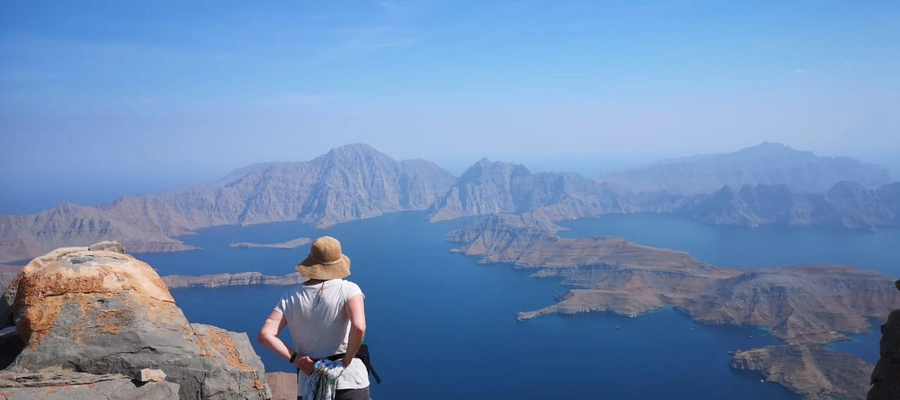
The fjord comparison makes most sense from height. Jebel Harim is the highest mountain in Musandam at 2,087 m. Its summit carries a radar installation, and the public track stops about 400 m before the top. Our half day 4WD safari to Jebel Harim climbs to about 1,784 m, passes the old stone houses of Bait Al Qafl and the acacia trees of the Khalidiya plain, and stops above Khor Najid on the way back down to Khasab.
With two days, the water first and the mountain second is the order that works best. The overnight dhow and Jebel Harim safari combines both from Dubai, so the khor you slept in is the one you look down on the next morning.
For experienced hikers, the Jebel Sham trek takes six to seven hours. It reaches ridges that overlook both Khor Sham and Khor Habalayn and passes an abandoned dry-stone village on the way up. Wadi Ain is the shorter option, four to five hours along a rocky riverbed to a waterfall.
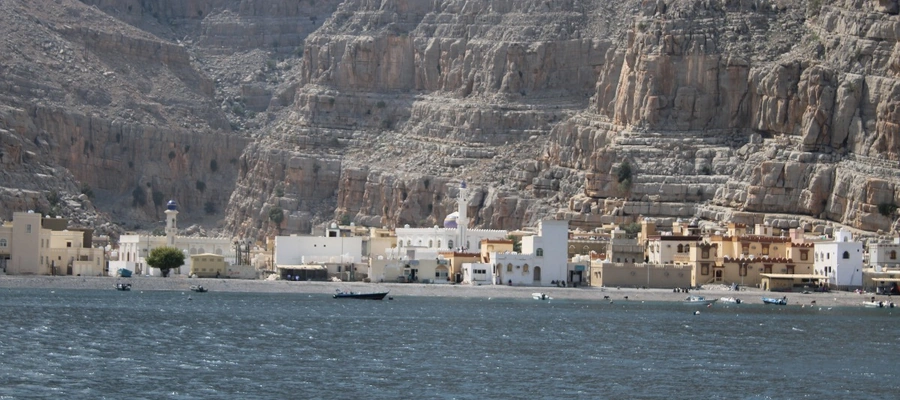
Kumzar sits on the Strait of Hormuz at the northern tip of the peninsula, the most northerly inhabited place on mainland Oman. There is no road to it from Khasab or from anywhere else, so building materials, food and people all arrive by boat. The 2010 census counted 1,378 residents, most of whom make their living from fishing.
The village is built into a narrow cove where the mountain wall comes down almost to the water, with houses packed onto every level patch. From May to September the heat in that enclosed cove is hard to live with, and most families move to Khasab, where many keep a second house and help with the date harvest. If you want to see Kumzar lived in rather than half shuttered, go between October and April.
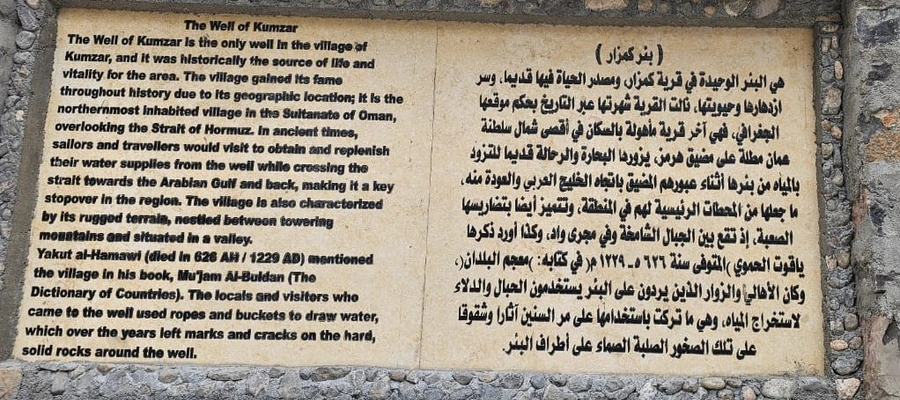
The people of Kumzar speak Kumzari, a Southwestern Iranian language related to Persian and Luri, with a large layer of Arabic vocabulary. The 2015 reference grammar by Christina van der Wal Anonby, published by Leiden University, describes it as "a mixed Perso-Arabian language of Oman". Estimates put the number of speakers at 4,000 to 5,000, and UNESCO lists Kumzari as severely endangered.
Where it is spoken explains a lot. Besides Kumzar itself, Kumzari is heard in the Harat al-Kamazirah quarter of Khasab, in parts of Dibba, and on Larak Island on the Iranian side of the Strait. At its narrowest the Strait of Hormuz is 39 km (21 nautical miles) across, with Iran on the north shore and Musandam on the south. For a village with no road inland, the people on the other side of that water were easier to reach than most of Oman, and the language still carries that connection. Residents also speak Arabic, so a greeting in Arabic is the polite way to start a conversation ashore.
Kumzar is not on the standard Khor Sham cruise. Our supplier, Musandam Sea Adventure in Khasab, runs a separate full day dhow cruise to Kumzar from 10:00 to 16:00 with lunch. It follows the north coast past small fishing villages and stops to swim and snorkel on the way. For groups of up to ten it is priced per boat rather than per person, so it suits a family or a group of friends travelling together better than a couple.
Kumzar is a working fishing village, not a museum. Cover shoulders and knees when you step ashore, ask before photographing people, and expect the timings on the day to depend on the sea state. Because the cruise starts at 10:00 in Khasab, guests coming from the UAE usually stay the night before in Khasab or pair it with an overnight on the dhow.
Ask about the Kumzar dhow cruise. Send your dates and group size and we will confirm the boat and the price for your group.
Most guests only have a day or two, so the useful question is which part of the coast to see. Here is how each option matches what you want to see.
| You want | Choose | Starts from |
|---|---|---|
| The khors in one day, with no Oman border fee | Dibba dhow cruise | Dubai hotel, 06:00 pickup |
| Khor Sham, Telegraph Island and dolphins | Khasab full day dhow | Dubai hotel, 06:00 to 06:30 pickup |
| A night anchored inside the khor | Khasab overnight dhow | Dubai hotel |
| A night on a beach reached only by boat | Musandam beach camping | Dubai hotel |
| The khors from 1,784 m | Jebel Harim safari | Khasab |
| Khasab Fort and the Tawi rock carvings | Khasab city tour | Khasab |
| Two days, sea and mountain, from Abu Dhabi | Overnight dhow and safari from Abu Dhabi | Abu Dhabi hotel, about 04:30 pickup |
| Khor Sham from Abu Dhabi with a Dubai night in between | Khasab day tour from Abu Dhabi | Abu Dhabi |
| Kumzar village | Kumzar dhow cruise, on request | Khasab harbour, 10:00 |
For prices and every departure in one place, see our Musandam tour packages from Dubai.
All Khasab tours cross the Oman border at Tibat. Budget AED 85 per passport for the crossing, which is the AED 35 UAE exit fee plus the OMR 5 Oman visa under our supplier's 2026 to 2027 terms. Carry an original passport with at least 60 days of validity. Rules change with nationality and residency status, so read our Musandam border crossing and visa guide before you confirm. The Dibba cruise has no Oman border fee, and UAE residents travel on their Emirates ID.
Pack for sun and water rather than cold. There is a full packing list for a day on the dhow, and if you are deciding between a traditional dhow, a speedboat and the Rubba yacht, this comparison of Musandam boat trips sets them side by side.
Because its northern coast is cut into long, narrow inlets with cliffs dropping straight into deep water, which look like Norwegian fjords from a boat. Locally they are called khors. The name describes the view, not the geology: the khors are drowned river valleys, not glacial fjords.
No. A fjord is a valley cut by a glacier and then flooded by the sea. No glacier has covered Arabia since the Permian period. The Musandam khors are rias: river valleys that flooded as the land sank, at roughly 6 mm a year, while the Eurasian plate overrides the Arabian plate.
Yes, but only by boat, because no road reaches Kumzar. Our supplier in Khasab runs a full day dhow cruise to Kumzar from 10:00 to 16:00 with lunch. For groups of up to ten it is priced per boat, so ask on WhatsApp with your dates and group size. Most residents move to Khasab from May to September, so October to April is the time to see the village lived in.
Kumzari, a Southwestern Iranian language with a large Arabic vocabulary, described in its reference grammar as a mixed Perso-Arabian language of Oman. It has an estimated 4,000 to 5,000 speakers in Kumzar, Khasab, Dibba and on Larak Island in Iran. UNESCO lists it as severely endangered. Residents also speak Arabic.
For Khasab tours you cross the Oman border at Tibat and pay AED 85 per passport, made up of the AED 35 UAE exit fee and the OMR 5 Oman visa, with an original passport valid for at least 60 days. Requirements change with nationality and residency, so check our border crossing guide before booking. The Dibba cruise has no Oman border fee and UAE residents travel on their Emirates ID.
Khasab tours cruise Khor Sham, stop at Telegraph Island and cross the Oman border at Tibat, so you need your passport and pay the border fee. Dibba tours cruise the southern khors from Dibba with no Oman border fee and a shorter drive from Dubai. Kumzar, Jebel Harim and the Khasab overnight options are reached only from Khasab. Our Dibba cruise page compares the two in more detail.
October to April, when the air is cooler and the sea is calm enough for long days on the dhow. From May to September daytime heat makes mountain safaris and treks hard work, and most Kumzar families leave the village for Khasab. Dhow cruises run all year, weather permitting.