


 Destination
  Verified
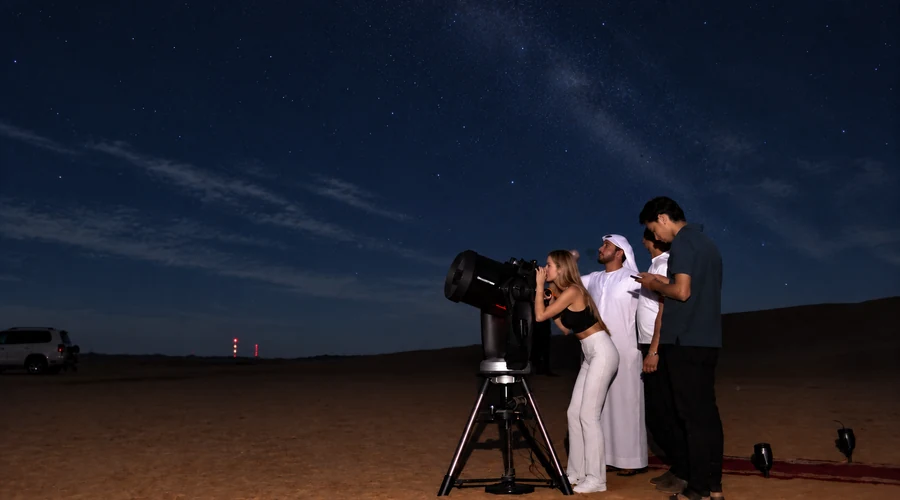
The galactic core of the Milky Way is only visible from the UAE between May and October. Outside this window, the core is below the horizon or rises only briefly before dawn, making it effectively impossible to see. Within the season, visibility varies by month.
Good
The core rises after midnight and is visible in the early morning hours. Temperatures at Al Quaa are already warm but manageable overnight.
Peak
The galactic core is highest in the sky and brightest. Best viewing window from approximately 9 PM to 3 AM. The Perseids meteor shower adds to August nights.
Peak
Excellent conditions. The core is visible from early evening. Temperatures begin to ease, making overnight camping notably more comfortable than summer.
Good
The galactic core sets earlier each week through October. Still worthwhile in the first half of the month. The season ends as November approaches.
A full moon at Al Quaa is bright enough to wash out the Milky Way almost entirely. Even a half moon reduces visibility significantly. The best conditions for al quaa milky way viewing come in the five to six nights either side of a new moon, when the sky is at its darkest between sunset and moonrise, or when the moon is below the horizon for most of the night.
This means the calendar date is almost irrelevant on its own. A visit on 20 August under a full moon will produce a far inferior result to a visit on 5 August under the waning crescent. Plan around the lunar calendar first, then check whether your chosen dates fall within the May to October season.
The following new moon windows fall within the remaining Milky Way season for 2026. All times are Abu Dhabi (GMT+4). Optimal viewing spans roughly five to six nights either side of the new moon date.
| New Moon | Date and Time (Abu Dhabi) | Best Viewing Window | Notes |
|---|---|---|---|
| August | 12 Aug, 9:36 PM | 8 to 16 August | Perseids peak 12 to 13 Aug. The best window of the year. |
| September | 11 Sep, 7:26 AM | 8 to 16 September | Cooler overnight temperatures. Strong visibility, no meteor bonus. |
| October | 10 Oct, 7:50 PM | 7 to 15 October | Core sets earlier. First half of the window is stronger. Final good opportunity of the season. |
After 15 October, the galactic core sets too early in the evening to make Al Quaa desert Milky Way viewing practical for most visitors. The season then closes until May 2027.
The Perseids meteor shower runs annually from mid-July to late August, with peak activity around 12 to 13 August. In 2026, this peak falls almost exactly on the new moon, creating what is, in practical terms, the best single stargazing opportunity of the year in the UAE.
On a clear night from Al Quaa during the Perseids peak, observers can expect to see 50 to 100 meteors per hour under ideal conditions. The shower radiates from the Perseus constellation, which rises in the north-northeast, but meteors are visible across the whole sky. No equipment is needed: the naked eye is sufficient.
For astrophotographers, the August new moon window at al quaa milky way spot represents the best annual opportunity for the UAE. You can frame both the galactic core and meteor trails in the same long-exposure shot from a dark-sky location with no technical complications.
Season and moon phase set the ceiling for what is possible. Atmospheric conditions determine what you actually see on any given night.
The UAE summer brings haboob dust storms and high humidity, which can reduce sky transparency significantly even when the core is theoretically visible. The clearest nights at al quaa desert milky way tend to come after a stable weather period of two or more days with no significant wind.
Practically speaking, check a sky transparency forecast the day before your visit using a tool such as Clear Outside or Astroplanner. A transparency rating of "good" or above at Al Quaa on a moonless night will produce a clearly visible Milky Way. "Poor" transparency on the same night can reduce it to a faint smear.
Al Quaa is approximately 150 km from Abu Dhabi city via E22, roughly a two-hour drive. Mobile signal becomes unreliable before you reach the spot, so download an offline map before leaving. The nearest fuel stop is around 50 km from the site.
The Al Quaa Milky Way Spot itself has an automatic barrier at the entrance that opens when you drive up. Regular cars are sufficient; the route is on paved road. Arrive early enough to set up before full dark, and allow at least 20 minutes after arriving for your eyes to dark-adapt before judging the sky quality.
If you would prefer to have the transfer, camp setup and hospitality handled, Arabiers offers an overnight Al Quaa desert camping tour from Abu Dhabi that includes return transfer, private Arabic seating, refreshments and an optional BBQ dinner.
For context on how Al Quaa fits into the wider Abu Dhabi desert experience, the Abu Dhabi Desert Safari guide covers the full range of day and overnight options available from the city.
The Al Quaa Milky Way spot best time to visit is not a single date but a combination of season and lunar window. Get both right, pick a night with good sky clarity, and Al Quaa will deliver one of the most striking night skies accessible from any major UAE city.