


 Destination
  Verified
| Factor | What to expect in Liwa |
|---|---|
| Climate type | Hot desert (Köppen BWh). Two real seasons, winter and summer, with short transitions in between. |
| Best months | December to February for comfort. November and March are excellent shoulder months. |
| Hottest months | July and August. Afternoon highs of 44 to 46°C are normal; Mezaira has recorded 49.6°C and 50.3°C. |
| Coldest nights | December to February. Dawn readings of 10 to 12°C are common; Mezaira is regularly among the five coldest UAE stations. |
| Rainfall | Under 50 mm a year, almost all between December and March. Many years see fewer than five rain days. |
| Humidity | Low. Around 30 percent in May rising to about 55 percent in December. Far drier than the coast. |
| Wind and dust | Calm most of the year. The Shamal brings blowing dust mainly between February and April, and again in June. |
| Sunshine | Over 3,500 hours a year. June has the longest days at roughly 13 hours 40 minutes; December the shortest at about 10 hours 40 minutes. |
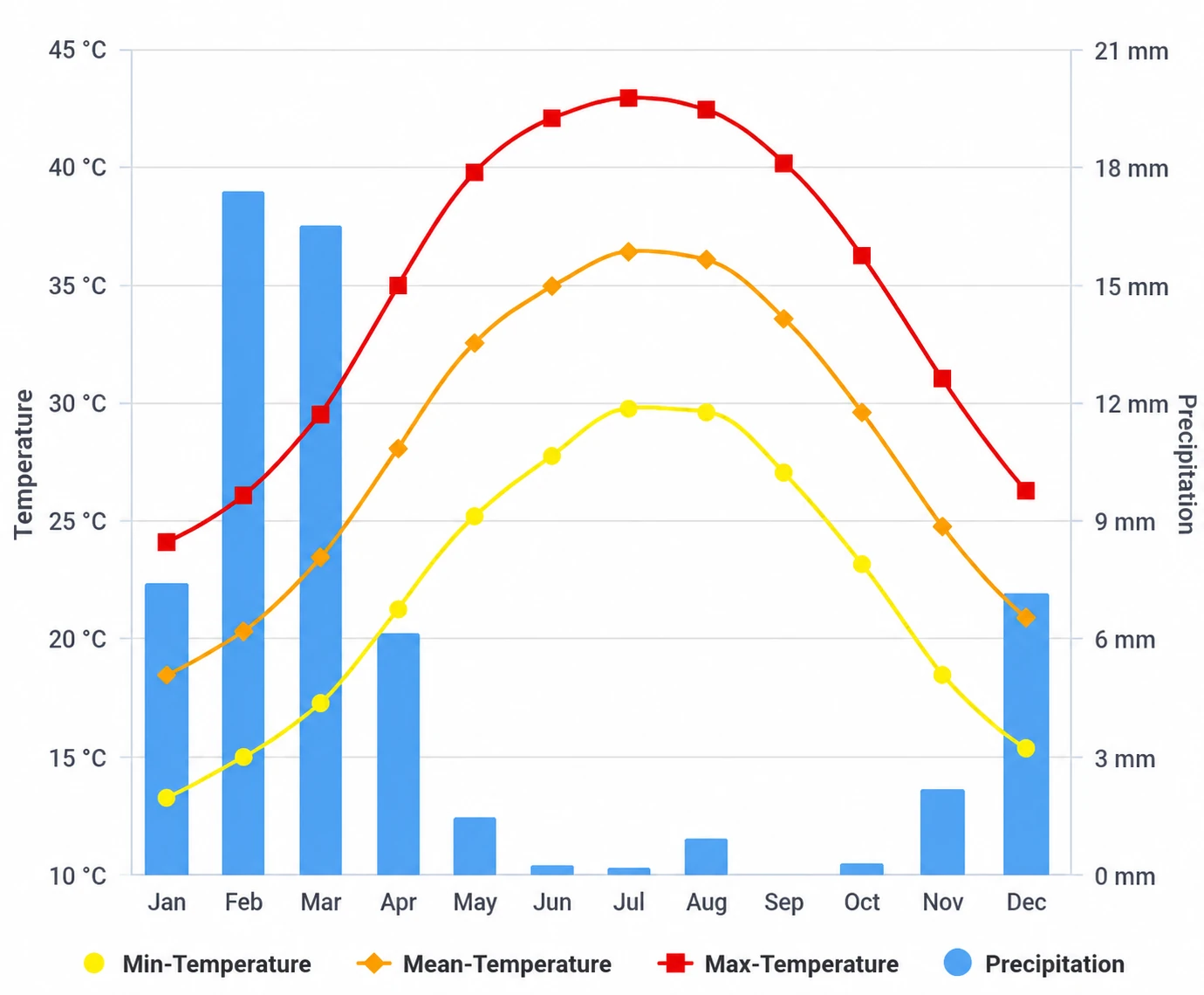
The figures below are typical values for Mezaira in Liwa. Day highs are afternoon readings; night lows are the coolest point just before sunrise. Recent NCM readings are included so you can see how far a real day can move from the average.
| Month | Typical day high | Typical night low | Humidity | Recent NCM readings at Mezaira | Desert safari rating |
|---|---|---|---|---|---|
| January | 24°C | 11°C | 50 to 55% | Dawn lows below 10°C in cold spells | Best |
| February | 27°C | 13°C | 45 to 50% | 31°C high on 27 February 2026 | Best |
| March | 31°C | 16°C | 40 to 45% | Warm afternoons, cool nights | Very good |
| April | 36°C | 20°C | 35 to 40% | First days above 40°C by late month | Good, early starts |
| May | 41°C | 24°C | 30 to 35% | 44.4°C on 8 May 2026; 20.7°C low on 15 May 2026 | Dawn and sunset only |
| June | 44°C | 27°C | 30 to 35% | 23.2°C low on 19 June 2025 was the coldest in the UAE that day | Dawn and sunset only |
| July | 45°C | 29°C | 30 to 40% | 49.6°C on 27 July 2025; 50.3°C on 31 July 2025; 48.6°C on 23 July 2026 | Not recommended |
| August | 45°C | 29°C | 35 to 40% | Peak heat, nights stay above 27°C | Not recommended |
| September | 42°C | 26°C | 35 to 45% | 21.5°C low on 20 September 2025 | Dawn and sunset only |
| October | 38°C | 22°C | 40 to 45% | Noticeable drop in the second half of the month | Good |
| November | 31°C | 17°C | 45 to 50% | 13.3°C low on 11 November 2025 | Very good |
| December | 26°C | 13°C | 50 to 55% | 10.7°C on 1 December 2025; 11.5°C on 10 December 2025 | Best |
Typical values are compiled from long term climate data for Liwa and Al Dhafra. Dated readings are NCM daily bulletins for the Mezaira station.

Winter is Liwa's season. Days sit between 22 and 27°C with almost unbroken sunshine, which is warm enough for a full day on the dunes and cool enough that you can climb Moreeb Dune on foot without suffering. Humidity is the highest of the year at around 50 to 55 percent, but that is still comfortable and it gives the dawn light a soft haze that photographers love.
The surprise for most visitors is the nights. Once the sun sets the sand gives up its heat quickly, and by 5 or 6 a.m. the Mezaira station is often reading 10 to 12°C. On 1 December 2025 it recorded 10.7°C, and on 10 December 2025 it was 11.5°C, both among the lowest in the country that morning. In a cold northerly spell, single digit readings are possible. If you are camping, this is the coldest part of the trip and the reason we brief guests to bring a proper jacket.
Winter is also when the region's biggest event takes place. The Liwa International Festival at Tal Moreeb, with its hill climb, drag racing and heritage programme, runs from 11 December 2026 to 2 January 2027. Weekend traffic on the Hameem road and around Moreeb Dune is heavy during the festival, so weekday departures are quieter. Our Liwa Day Tour can be combined with festival viewing on those dates.
Winter verdict: the best time for every Liwa product, including overnight camping. Book early for December and January weekends.
March is still excellent. Days of 29 to 33°C, nights around 15 to 17°C and long evenings make it a strong alternative to peak winter with fewer visitors. April is the transition month: the first half is comfortable, but by the last ten days afternoon readings push past 38°C and can touch 40°C. On 8 May 2026 Mezaira recorded 44.4°C, which is a normal May afternoon rather than an exception.
Spring is also the windiest part of the year. The north westerly Shamal wind is most active between February and April and carries fine sand off the dune crests. Most days it simply makes the ridgelines smoke; a few days a year it reduces visibility enough that we change the route or reschedule. Humidity falls to its lowest point of the year in May at around 30 percent, so the heat is dry rather than sticky.
Spring verdict: March is a top three month. April works with an early start. May is dawn and sunset only, with a midday retreat to Qasr Al Sarab.
Liwa in summer is one of the hottest inhabited places in the UAE. Mezaira and the neighbouring Al Dhafra stations (Hamim, Al Jazeera B.G., Bada Dafas) regularly top the NCM's daily list. In late July 2025 the station logged 49.6°C and then 50.3°C within a week, and on 23 July 2026 it reached 48.6°C. Night lows of 27 to 30°C mean the sand never fully cools.
The one advantage Liwa has over the coast is humidity. Dubai and Abu Dhabi in August combine 42°C with 60 to 80 percent humidity, which is why the heat there feels suffocating. Liwa's air is drier, typically 30 to 40 percent, so shaded early mornings and post sunset hours are more bearable than the raw temperature suggests. That is the window our summer tours use: a 5 a.m. departure for a dawn dune drive, or a late afternoon start that puts you on the dune crest as the sun drops.
Overnight camping and trekking pause between June and September. It is not safe to sleep out when the ground is still radiating 35°C heat at midnight, and we do not offer it. Summer is, however, when Qasr Al Sarab and Tilal Liwa run their lowest room rates, and the Qasr Al Sarab Lunch and Liwa Day Tour is built around an air conditioned midday break for exactly this reason.
One event does fall in summer: the Liwa Dates Festival, an agricultural and heritage fair held in July at Liwa Oasis. It is a different event from the winter motorsport festival at Moreeb Dune, and it takes place indoors and in shaded pavilions.
Summer verdict: July and August are not recommended for desert activity. June and September are possible at dawn and sunset for experienced, well prepared visitors.

Autumn arrives late and fast. The first half of October still delivers 38 to 40°C afternoons, but nights drop into the low 20s and the change accelerates through the month. By the first week of November the daytime high is typically around 31°C, and on 11 November 2025 Mezaira recorded a dawn low of 13.3°C, the second coldest reading in the UAE that morning.
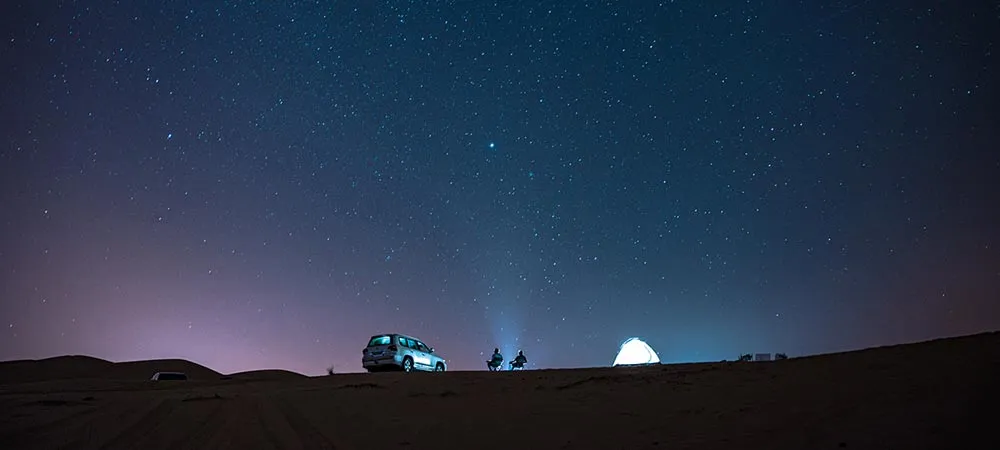
Skies are exceptionally clear in autumn because the summer dust has settled and the winter humidity has not yet arrived. This is the best stargazing period of the year and the reason our Liwa Overnight Camping season reopens in October. Wind is at its calmest and rain is almost unheard of.
Autumn verdict: late October is good, November is very good. Camping returns from October with cool, dry nights.
Liwa is one of the driest inhabited places in the country. Annual rainfall is well below 50 mm and many years bring less than 10 mm. What rain does arrive comes between December and March as short, localised showers linked to winter low pressure systems, and it usually dries within hours. In the Empty Quarter rain is a photographic gift, not a cancellation risk.
The Shamal is a north westerly wind that runs the length of the Gulf. It has two active periods: a winter Shamal between roughly February and April, and a summer Shamal that peaks in June. Wind speeds in Liwa average a gentle breeze, but sustained gusts in the high teens of knots in April are enough to lift sand off the crests. On a handful of days a year visibility drops below 1,000 metres and the NCM issues a dust warning. Our drivers check the forecast the afternoon before every departure and will reroute to the more sheltered dune fields or move the tour by a day at no charge.
Between December and February the combination of cool nights and higher humidity produces dawn fog in the hollows between dunes. It is thin and usually burns off by 8 a.m., but it is worth knowing about if you are driving yourself on the E45 or E65 before sunrise.
Deserts lose heat fast for three reasons, and all three are extreme in Liwa. First, the air is dry, so there is little water vapour to trap the day's warmth after sunset. Second, sand has a low heat capacity: it heats quickly in the morning and cools just as quickly at night. Third, there is no cloud, so radiation escapes straight to space. The result is a day to night temperature swing of 13 to 17°C almost every day of the year.
In practice, a January afternoon of 24°C becomes an 11°C dawn, and a July afternoon of 45°C becomes a 29°C dawn. For visitors this means two things: pack for both ends of the day, and remember that the first hour after sunrise and the last hour before sunset are the sweet spots in every season.
| Activity | Best months | Possible months | Avoid |
|---|---|---|---|
| Dune bashing and Moreeb Dune drive | November to March | October, April (early starts) | June to September midday |
| Overnight camping in the Empty Quarter | November to February | October, March | June to September (not offered) |
| Stargazing and Milky Way photography | October, November, February, March | December, January (some dawn haze) | Summer dust season |
| Sunset on the dunes | October to April | May, September | July, August |
| Walking and dune trekking | December to February | November, March | April to October |
| Liwa International Festival at Moreeb Dune | 11 December 2026 to 2 January 2027 | Winter only; dates are set annually | |
| Liwa Dates Festival | July | Held indoors and in shaded pavilions at Liwa Oasis | |
| Qasr Al Sarab lunch or dinner tours | October to April | All year (air conditioned midday break) | None |
Daytime: light trousers, a t-shirt or long sleeved cotton shirt, sunglasses and a hat. The sun is still strong at midday. Evening and dawn: a fleece or down jacket, a beanie or scarf, and closed shoes with socks. Camping guests should treat the dawn as a 10°C morning, because it usually is. Lip balm and moisturiser help with the dry air.
Loose, light coloured, breathable fabrics by day, with a light layer for after sunset in March and November. A scarf or shemagh is useful on windy days when sand is lifting off the crests. High factor sunscreen is essential from April onwards.
Long, loose, light coloured cotton or linen covering arms and legs, a wide brimmed hat, UV sunglasses and a scarf you can wet and wear around the neck. Carry more water than you think you need; our vehicles stock it, but dehydration is the number one heat risk. Avoid black fabrics, tight synthetics and open sandals on hot sand.
Closed shoes for dune walking, a small daypack, a power bank, and a camera bag that seals against fine sand. If you plan to climb Moreeb Dune, expect the sand surface to be 15 to 20°C hotter than the air by early afternoon in any season.
All Arabiers Liwa tours are private Land Cruiser trips priced per vehicle, with pick up from Dubai or Abu Dhabi and free cancellation up to 24 hours before departure. That last point matters here: if the NCM forecast changes, you can move your date without penalty.
For Liwa Oasis itself, the date farms and the fort, timing is less critical because the palm groves are shaded. Read our guide to Liwa desert safari tours from Abu Dhabi for prices, distances and a comparison with a Dubai desert safari.
Tell us your dates and we will recommend the right tour, start time and pick up point for the conditions. Private Land Cruisers, Emirati guides with Empty Quarter permits, and free cancellation up to 24 hours before departure.
January and February are the most comfortable months, with daytime highs around 24 to 27°C and nights near 11 to 13°C. December and March are close behind. If you want the Moreeb Dune Festival, plan for mid December to early January.
Very hot. Typical July and August afternoons reach 44 to 46°C, and the NCM station at Mezaira in Liwa has recorded readings of 49.6°C and 50.3°C in late July. Nights rarely fall below 27°C. Guided tours run at dawn or after sunset only, and overnight camping is not offered in summer.
Rarely. Liwa receives well under 50 mm of rain in a typical year, almost all of it between December and March as short showers. A tour being cancelled for rain is unusual; wind and visibility are the more common weather reasons to adjust an itinerary.
Yes, colder than most visitors expect. Between December and February the NCM regularly records Mezaira among the coldest places in the UAE, with dawn readings of 10 to 12°C. Overnight camping guests should pack a warm layer, a hat and closed shoes for the early morning.
Less humid. Liwa is around 240 km inland from the Gulf, so it misses the coastal humidity that makes Dubai and Abu Dhabi summers feel oppressive. Daytime temperatures are higher than on the coast, but the air is drier and evenings cool down faster.
The Liwa International Festival at Tal Moreeb runs in winter. The 2026 to 2027 edition is scheduled from 11 December 2026 to 2 January 2027. Expect sunny days of 22 to 26°C and cold nights of 10 to 14°C. This is a separate event from the Liwa Dates Festival, which is held in July.
Day tours can run in summer with an early start and a midday break at Qasr Al Sarab, and sunset tours run after the worst of the heat has passed. Overnight camping and trekking pause between June and September. Free cancellation applies up to 24 hours before departure on all Liwa tours if the forecast changes.
Fully blown sandstorms are uncommon, but blowing dust and reduced visibility happen a few times a year, most often with the north westerly Shamal wind between February and April and again in June. Arabiers guides check the NCM forecast the day before every departure and will reroute or reschedule if visibility is poor.