



 Destination
  Verified

UAE hospitals and clinics publish their doctors' names, specialties and credentials on their websites. Many provide full profiles of each consultant's specialisation. You can call the hospital directly to ask about a specific doctor and the maternity facilities available. Staff in UAE hospitals typically speak Arabic and English, and often additional languages depending on the hospital's patient base.
Once you have chosen a hospital and obstetrician, contact the hospital to open a new patient file. This is required before you can book an appointment.
To open a new patient file at a Dubai hospital you will typically need:
Natural birth and caesarean section are available at all major UAE hospitals. Some hospitals offer water births, though this is less widely available. Discuss your preferred method with your obstetrician early to confirm what the hospital can accommodate and whether any medical conditions might affect your options.
A UAE visitor visa is typically valid for 30 or 60 days from entry. If your delivery date falls close to or after your visa expiry date, you must apply for a UAE visit visa extension before the current visa expires. Extensions are available in 30-day increments and are processed from inside the UAE. There is no grace period : overstay fines of AED 50 per day begin from the first day after expiry with no exceptions.
Do not let your visitor visa expire during the pregnancy. If you are staying in Dubai through the delivery and into the postnatal period, plan your visa extension well before the expiry date. The hospital process, birth registration, and newborn visa steps all take time : give yourself enough valid visa duration to complete them without pressure.
Maternity care in Dubai is expensive. The figures below are indicative ranges. Confirm current costs with the hospital directly before proceeding : prices change and vary significantly by hospital, doctor and delivery type.
| Setting and delivery type | Approximate cost range |
|---|---|
| Private hospital: natural delivery | AED 22,000 to AED 30,000 |
| Private hospital: caesarean section | Above AED 30,000 |
| Government hospital: delivery | AED 7,000 and above |
These figures cover the delivery itself. Antenatal consultations, scans, blood tests and any additional procedures are charged separately. Ask the hospital for a full written cost estimate at your first appointment and confirm what is and is not included.
Every expatriate employed in the UAE is required by law to hold medical insurance through their employer. If your spouse is employed and resident in the UAE, confirm that their insurance package includes maternity cover before any costs are incurred. Not all employer-provided policies in the UAE include maternity, and coverage limits vary widely.
If you are visiting Dubai on a tourist visit visa without UAE employer-sponsored insurance, you will likely be paying all maternity costs out of pocket. Standard travel insurance policies typically exclude planned deliveries. Some policies cover emergency obstetric care but not routine delivery costs.
Before you travel: if you are pregnant and considering travelling to Dubai near your due date, contact your travel insurer in advance to confirm exactly what is and is not covered. Do not assume maternity care is included in a standard travel policy.
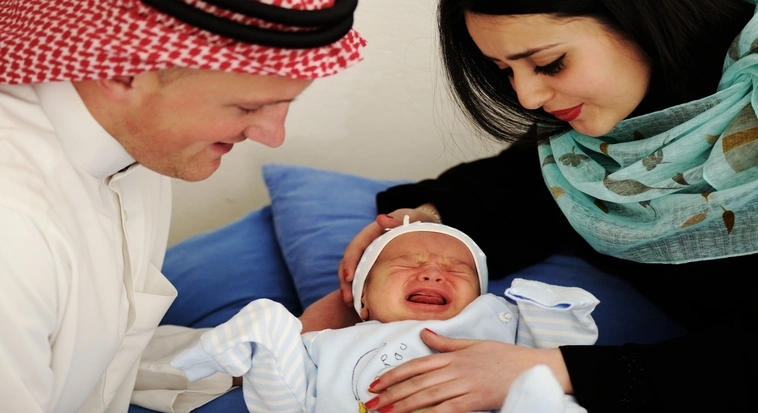
The hospital provides a UAE birth notification document immediately after delivery. This is not the same as a birth certificate : it is a UAE administrative document that you use to obtain the birth certificate and to start the newborn's visa process.
Birth registration is typically handled by the hospital as part of the delivery paperwork through the UAE Ministry of Health or the relevant emirate authority. Ask the hospital administration team exactly what they handle and what you need to follow up yourself.
Take the hospital birth notification to your country's consulate or embassy in Dubai or Abu Dhabi to apply for the official birth certificate. An attested marriage certificate is a mandatory document for most nationalities. Confirm the specific requirements with your consulate as they vary by nationality and can take several working days to process.
Your baby will need a passport from your home country to travel internationally. Apply through your consulate using the birth certificate and birth notification. Processing time varies significantly by nationality : confirm with your consulate how long this takes so you can plan your departure or extended stay accordingly.
If you or your spouse holds a UAE residence visa and you intend the child to live in the UAE, apply for the newborn's residence visa within 120 days of the birth. See the section below for eligibility requirements and the full document checklist.
If your child is born in the UAE and you are a UAE resident, you must apply for a UAE residence visa for your newborn within 120 days of birth. Missing this deadline results in a fine of AED 100 per day from the first day after the deadline. The process follows the same route as applying for a family residence visa in the UAE.
The 120-day window: confirm with ICP or GDRFA whether the 120-day period is counted from the date of birth or from the date the birth certificate is issued, as this distinction matters if there are any delays in the consulate process. The AED 100 per day fine applies once the deadline passes.
The sponsoring parent must meet both of the following conditions:
Confirm current salary thresholds with ICP before starting the application, as these are periodically updated. If you need to change your visa status before applying to sponsor the newborn, the airport to airport visa change or an in-country status change may apply depending on your situation.
Prepare all of the following before starting the application. Missing documents will delay the process.
If you need to extend your visitor visa while the newborn's documents are being processed, apply before your current visa expires. The extension can be renewed in 30-day increments for as long as needed while you complete the steps above. If you eventually need to switch to a long-term residency option, a UAE Golden Visa may be worth exploring for longer-term stays in the country.
Apply for a UAE tourist visa extension : processed from inside the UAE, no exit required.
Yes. There is no restriction on giving birth in Dubai while on a visitor visa. Both private and government hospitals are accessible. Without UAE health insurance, however, you will pay the full delivery cost privately : from approximately AED 22,000 to AED 30,000 or more in a private hospital for a natural delivery, and above AED 30,000 for a caesarean section.
Yes, if your visa will expire before you are ready to leave. Apply for a UAE visit visa extension before your current visa expires. Extensions are available in 30-day increments. Overstay fines of AED 50 per day begin from the first day after expiry with no grace period.
Typically: a medical insurance card (if you hold one), an attested marriage certificate, original and copies of both parents' passports, and original and copies of both parents' residence or visitor visa. Confirm with the specific hospital before your first visit as requirements vary.
120 days from birth. If you exceed this deadline, a fine of AED 100 per day applies from the first day after the deadline. Confirm the current rules and whether the 120 days is counted from birth or from the date the birth certificate is issued, as consulate processing can take time. Apply as early as the documents allow.
A minimum of AED 4,000 per month, or AED 3,500 if the employer provides accommodation. The sponsor must also hold a valid UAE residence visa and Emirates ID. Confirm current thresholds with ICP before applying.
Take the hospital birth notification to your country's consulate or embassy in Dubai or Abu Dhabi. An attested marriage certificate is required for most nationalities. Confirm the exact requirements and processing time with your consulate directly.
Standard travel insurance policies typically exclude planned deliveries and routine maternity care. Some cover emergency obstetric care. Confirm your policy with your insurer before travelling to Dubai while pregnant : do not assume maternity is covered.
Yes, once your baby has a passport from your home country. Apply for the passport through your consulate using the birth certificate and hospital birth notification. Processing time varies by nationality. If you need to stay in the UAE longer term, apply for the UAE family residence visa for your newborn within 120 days of birth.
If you need a new visa urgently, express UAE visa processing delivers approval in 4 to 8 hours on UAE working days. However, if you are already inside the UAE, you should apply for a tourist visa extension rather than a new visa : this keeps you in the country legally without needing to exit and re-enter.