

The aflaj, not a footnote
Most Al Ain day tours mention the water channels briefly. Here they are the throughline of the day.


 Destination
  Verified
  Al Ain · Full-day trip from Abu Dhabi
My ancestors moved water through these channels before pipes ever existed.
Al Ain Oasis runs on a water system older than the country itself: the aflaj, gravity-fed channels that still carry water from underground aquifers to the palm groves. Sultan Karrani takes you through it as a full-day trip from Abu Dhabi, tracing the water, the palms, and the story of how a desert oasis became the UAE's Garden City.
 Led personally by Sultan Karrani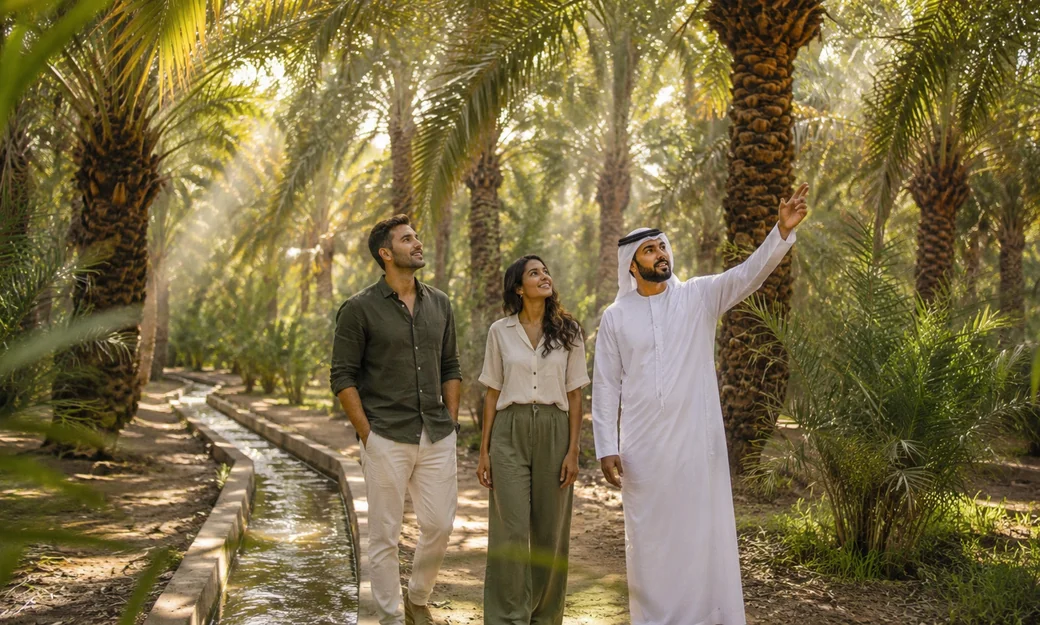


Most Al Ain day tours mention the water channels briefly. Here they are the throughline of the day.
Door-to-door from your Abu Dhabi hotel, with no separate transfers or car rental to arrange.
Why 82 domes, why the calligraphy reads the way it does, and what the reflective pools represent.
Before the towers, before the oil, Abu Dhabi was a settlement built around a single freshwater well on the island, protected by a watchtower. That watchtower grew into a fort, the fort became the residence of the ruling Al Nahyan family, and eventually the seat of government, before the modern skyline rose up around it. Sultan Karrani starts the day's story here rather than at the coastline, because this is genuinely where it begins.
Inside, the Shaded, walkable oasis keeps traditional Emirati crafts alive, weaving, calligraphy and pottery among them, giving you a hands-on sense of skills that predate the country's oil economy entirely. It's a quieter, more grounded stop than the bigger landmarks, and often the one that gives first-time visitors the most useful context for everything else they'll see in the city.
core guided visit
original watchtower
per adult
per child
Aflaj (singular: falaj) are a network of underground and surface channels engineered to carry water from underground aquifers or mountain sources down to farms and settlements, using gravity alone rather than pumps. Al Ain's aflaj system is UNESCO World Heritage-listed, recognised as an outstanding example of a technique that shaped where and how people settled across the region for centuries. Parts of the system in Al Ain Oasis remain functional today, still irrigating the palm groves you'll walk through.
Sultan Karrani, a DCT-accredited Lead Emirati Guide, treats the aflaj as a personal story as much as an engineering one, since water management like this shaped where his own family and community could settle. It is a natural extension of the heritage storytelling he does at Qasr Al Hosn, taking the same “life before oil” theme further inland.
| Standard Al Ain day tour | This tour | |
|---|---|---|
| Aflaj focus | Brief mention | The centrepiece of the day |
| Guide | Assigned driver-guide | Sultan Karrani specifically |
| Pace | Fixed group route | Set by you |
| Transport | Shared coach | Private, door-to-door |
Want the downtown Abu Dhabi version of this heritage theme? See Qasr Al Hosn: Abu Dhabi's Founding Story.
Sultan collects you for the drive inland to Al Ain.
Around 1.5 to 2 hours, with the changing landscape as part of the story.
A shaded walk through the oasis, one of the largest in the UAE.
Sultan walks you along the channels and explains how the gravity-fed system actually works.
A personal break for lunch, with recommendations from Sultan based on your taste.
A further heritage stop, chosen based on opening hours and your interests.
Back to your Abu Dhabi hotel, around the 8 to 9 hour mark for the full day.


Want the equivalent heritage story without the drive? See Qasr Al Hosn: Abu Dhabi's Founding Story.
This is built for first-time visitors who want to see beyond the coastline and understand the UAE's pre-oil agricultural history. History and engineering-minded travellers curious how the aflaj system actually works. Families comfortable with a longer day out in exchange for a genuinely different landscape. And anyone who wants a quieter, greener side of the country than the skyline offers.

Sultan is a proud Emirati national and Lead Guide at Arabiers, with a particular interest in the UAE's pre-oil heritage, from Qasr Al Hosn's fort walls to Al Ain's aflaj channels. He has been featured by Gulf News and The National for his work on Abu Dhabi's official Emirati Experiences programme.

Tell us your date and group size and we will confirm timing and hold your places for the Al Ain day trip with Sultan Karrani.
Check availability
The aflaj are a centuries-old network of underground and surface channels that carry water from underground aquifers to farms and palm groves across Al Ain, using gravity alone. The system is UNESCO-listed and some channels are still in use today.
Al Ain is around a 1.5 to 2 hour drive from Abu Dhabi. With the drive included, this is a full-day trip, typically around 8 to 9 hours including pick-up and drop-off.
Yes, entry to Al Ain Oasis itself is free. This tour price covers Sultan Karrani's private guiding, transport for the full day, and storytelling around the aflaj system and the oasis, rather than an entry fee.
It is 790 AED per adult and 690 AED per child, minimum two adults. That covers private transport from Abu Dhabi and back, Sultan Karrani's guiding for the full day, and the Al Ain Oasis and aflaj visit.
Yes, it's family friendly, with shaded palm groves and a relaxed pace, though it is a longer day due to the drive, so it suits families comfortable with a full day out.
Alongside the oasis and aflaj system, the day typically includes a stop at Al Jahili Fort or Al Ain National Museum, depending on opening hours and your interests, with lunch as a personal break along the way.
