Destination
  Verified
 Requirements, Cost and Realistic Timelines for UAE Residents
 Updated 14 July 2026
Applying for a Schengen visit visa while living in Dubai is not done at one European embassy counter. You apply to the country that is your main destination, give biometrics at its appointed visa centre in the UAE, and build a supporting file that proves the trip is genuine and that you will return home. This guide covers which country to apply to, the 2026 fees, the documents a UAE resident should prepare, realistic timings, and, using both European Commission figures and our own Dubai case data, the reasons applications from the UAE are most often refused.
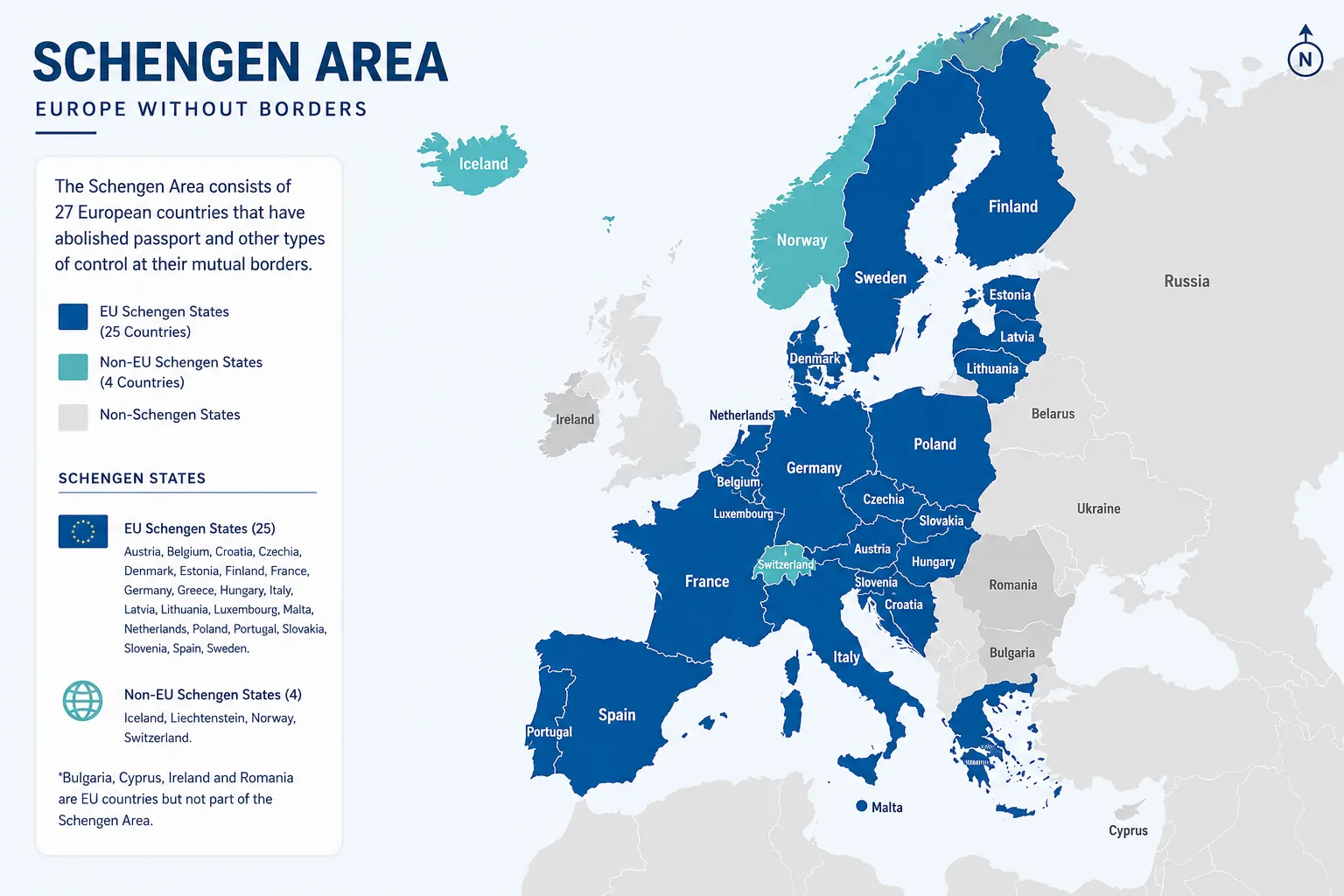
A short stay Type C permit to travel across the 29 Schengen states for up to 90 days in any 180 day period. It is not a residence or work permit.
Source: EU Visa Code 810/2009The consulate fee is 90 euros for adults, 45 euros for children 6 to 11, and free under 6. Insurance and a visa centre charge are added on top.
Source: European CommissionThe legal standard is 15 calendar days, up to 45 in complex cases. Across 214 recent Dubai files the observed median was 21 calendar days.
Source: EU Visa Code + first-party case dataThe country where you will spend the most nights. If nights are equal, the country of your first entry into the Schengen area.
Source: EU Visa Code, Article 5Yes. Travel medical cover of at least 30,000 euros, valid across the Schengen area for the full trip, is mandatory for every application.
Source: EU Visa CodeNo. The consulate fee is non-refundable once the application is submitted, whatever the outcome. Prepare the file fully before you apply.
Source: European Commission
This is the first and most important decision, and many refusals from Dubai start with getting it wrong. You do not simply pick the country you think is easiest. The rule is set in the EU Visa Code: you apply to your main destination, and the consulate checks your itinerary against it.
| Your trip | Where you apply |
|---|---|
| 7 nights France, 2 nights Belgium | France, the main destination |
| 4 nights Italy, 4 nights Spain, enter via Italy | Italy, the first point of entry |
| Single country trip to Germany | Germany |
Source: EU Visa Code, Regulation 810/2009, Article 5. A single Schengen visa then covers all 29 member states.
There is no European embassy counter in Dubai that decides the visa. You apply through the consulate or its appointed visa centre, such as VFS Global or BLS, you give biometrics in person, and a European consulate makes the decision. The stages are the same for every applicant.
A Schengen application has three cost layers: the consulate fee set at EU level, the service charge taken by the visa centre, and mandatory travel insurance. The consulate fee is the same for every Schengen country. The service charge and insurance vary.
| Cost component | Amount | Note |
|---|---|---|
| Consulate fee, adult | 90 euros (~AED 385) | Set at EU level, same for every country |
| Consulate fee, child 6 to 11 | 45 euros (~AED 190) | Reduced rate |
| Consulate fee, child under 6 | Free | No consulate fee |
| Visa centre service charge | Varies | Charged by VFS, BLS or TLScontact in the UAE |
| Travel medical insurance | Varies | Minimum 30,000 euros of cover for the whole trip |
Source: European Commission, Schengen visa fee rules. Dirham figures are approximate and move with the exchange rate. Confirm the current adult fee before applying.
Consulates publish their own checklists, and the exact list depends on the country and your purpose of travel. The core set below applies to almost every tourist and family visit application from the UAE. A Dubai resident adds a local layer that proves lawful residence and real ties to the UAE.
| Document | Why it is needed | Note for Dubai residents |
|---|---|---|
| Passport | Confirms identity and validity for the trip | Valid at least 3 months beyond return, two blank pages |
| UAE residence visa and Emirates ID | Proves lawful residence in the UAE | Valid at least 3 months beyond your return |
| Completed application form | States your trip, dates and destination | Must match your flights and hotels |
| Bank statements | Shows funds and a steady pattern | Usually the last 3 to 6 months, settled and explainable |
| Proof of employment or business | Confirms the source of income | Salary certificate, NOC, or trade licence if self employed |
| Travel insurance | Required for every application | Minimum 30,000 euros across the Schengen area |
| Flights and accommodation | Shows a genuine, planned trip | Return booking and lodging for every night |
| Cover letter | Ties the file together for the consulate | State who pays and your ties to the UAE |
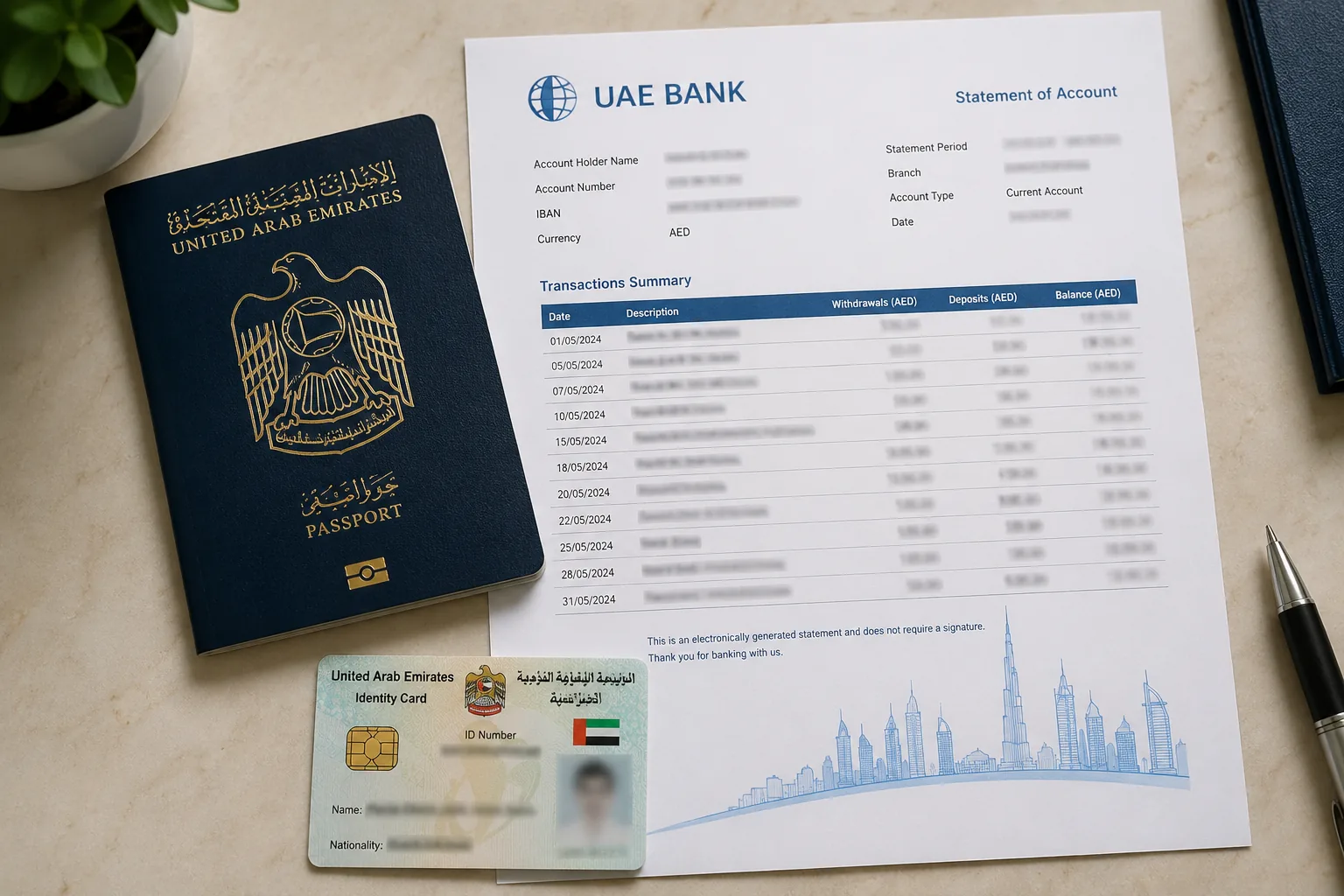
There is no single official minimum bank balance for a Schengen visa. Each consulate expects you to show that you can reasonably fund the trip and that the money is genuinely yours. A working guide many consulates use is enough to cover roughly 50 to 100 euros per day, plus flights and accommodation, though the exact figure varies.
What matters more than the headline number is the pattern. Consulates look for a steady balance built over three to six months, salary credits that match your employment letter, and no sudden deposit just before you apply. Across the files handled from Dubai, figures that did not add up were the single most frequent friction point.
| Red flag | Why it hurts | Fix |
|---|---|---|
| A large deposit days before applying | Reads as borrowed funds, not real savings | Build the balance over months, or prove the source |
| Statements that do not match the salary letter | Suggests the file was staged for the visa | Make salary credits and the letter agree |
| A balance that barely covers the trip | Leaves no margin and signals strain | Show a comfortable buffer above the trip cost |
| A sponsor with no clear link to you | Weakens the case for who funds the trip | Use a close family sponsor with proof and funds |
Public statistics tell you that applications lodged in the UAE are refused far more often than the low rate Emirati passport holders enjoy. They do not tell you why. To close that gap we reviewed our own recent files from the Dubai office and grouped the primary concern behind each difficult case.
Two findings stand out. Financial questions dominate: weak financial support and bank activity that does not match together make up 46.2 percent of primary concerns, close to half of all difficult cases. And the single largest individual concern, at 32.7 percent, is a thin travel history paired with other doubts, common for first time travellers from the UAE.
Sources: Arabiers first-party case data (own figures, not official statistics). European Commission, Migration and Home Affairs, 2024 visa statistics.
The EU Visa Code sets a standard decision time of 15 calendar days from the date a consulate accepts the application, extendable to 45 in complex cases. The final column is the observed median from our Dubai case data, which runs a little longer than the legal minimum and is a more realistic figure to plan around.
| Stage | Legal standard | Observed median (214 cases) |
|---|---|---|
| Standard decision | 15 calendar days | Around 21 calendar days |
| Complex or extra checks | Up to 45 calendar days | Varies by consulate and profile |
| Appointment wait in peak season | Not fixed | Often 2 to 3 weeks on top |
Source: EU Visa Code, Regulation 810/2009, and Arabiers first-party case data.
A visit visa turns on one belief: that you will leave the Schengen area and return to your life in the UAE. Long residence does not speak for itself unless the file shows it. In our case data, weak evidence of a reason to return was a primary concern in 12.6 percent of difficult files, and it often sits alongside a thin travel history. The evidence below carries the most weight.
| Evidence of ties | What it demonstrates to the consulate |
|---|---|
| Employment and salary certificate | An ongoing commitment and income to return to |
| Tenancy contract | A home in the UAE that continues past the trip |
| Family resident in Dubai | Personal ties that anchor the return |
| Business or trade licence | An enterprise that requires your presence |
| Confirmed return flight | A defined, temporary visit with an end date |
You can apply for a Schengen visit visa from the UAE if you hold a valid UAE residence visa with enough validity left, and you can show the purpose of your trip, the funds to support it, and a reason to return. Your nationality decides the documents and the level of scrutiny, but residents of almost every nationality apply successfully from Dubai every day.
The core points are a residence visa valid at least three months beyond your return, a passport with the same validity and blank pages, travel insurance, and a genuine, funded itinerary. If your residence visa is close to expiry, renew it before you apply, because a short remaining validity is itself a refusal reason.
Travel medical insurance is not optional. Every Schengen application needs cover of at least 30,000 euros for medical costs and repatriation, valid across the whole Schengen area and for every day of your trip.
| Requirement | Detail |
|---|---|
| Minimum cover | 30,000 euros, medical and repatriation |
| Area | Valid across the whole Schengen area |
| Duration | Every day of the trip, with a small margin either side |
| When to buy | Before your appointment, the certificate is part of the file |
Source: EU Visa Code, Regulation 810/2009.
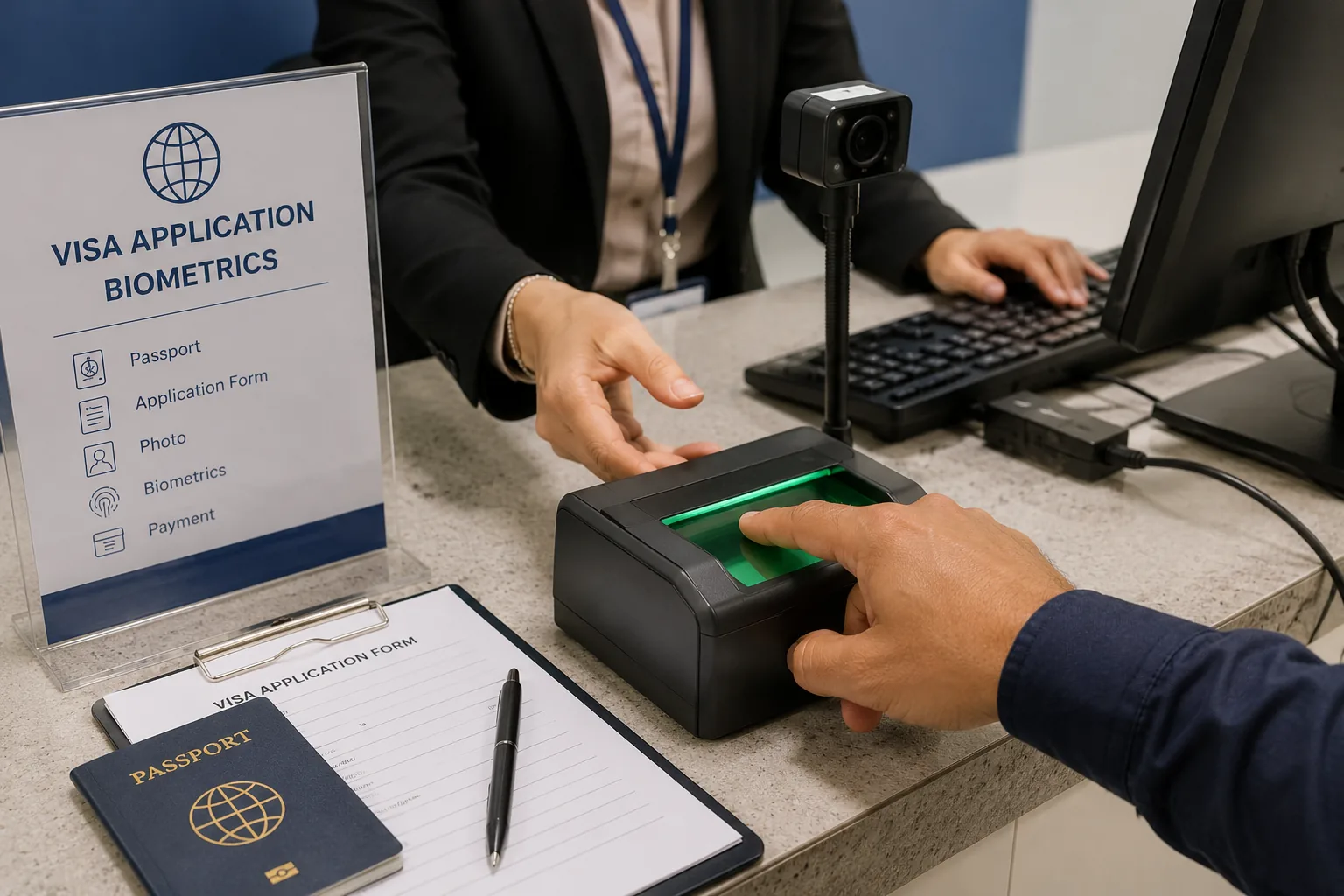
Most Schengen countries collect applications through an outsourced visa centre in the UAE rather than at the embassy directly. At the appointment you submit your documents and give biometrics, meaning fingerprints and a photograph. Biometrics are stored and reused for five years, so if you have applied recently you may not need to give them again. Free standard slots fill quickly in peak season, so booking early matters more than paying for a premium slot.
A short stay Schengen visa lets you travel for up to 90 days within any 180 day period across all 29 member states. The 90 days are counted across the whole area, not per country, and the 180 day window rolls backwards from any day you are in the zone. It allows tourism, family visits and business meetings. It does not allow paid work or long term residence.
| Feature | What it means |
|---|---|
| Coverage | All 29 Schengen states on one visa |
| Length of stay | Up to 90 days in any rolling 180 day period |
| Purpose allowed | Tourism, family visits, business meetings |
| Not allowed | Paid work or long term residence |
Approval outcomes do vary by consulate, and that variation is real. It should guide which genuine main destination you build a trip around, not tempt you into a false itinerary. European Commission figures for applications lodged in the UAE in 2024 show wide differences between consulates.
| Consulate in the UAE | Refusal rate, 2024 | Read this as |
|---|---|---|
| Malta | About 45.9% | Among the strictest for UAE-filed applications |
| Croatia | About 42.6% | High refusal, low volume |
| Sweden | About 40.7% | Strict Nordic consulate |
| Denmark | About 31.8% | High volume and high refusal |
| Germany | Lower than the above | Most preferred destination from the UAE by volume |
Source: European Commission, Migration and Home Affairs, 2024 visa statistics, as reported by Gulf News and Khaleej Times.
A refusal comes with a stated reason, and that reason is the brief for your next step. The most common grounds map closely to the concerns in our case data: doubts about funds, a reason to return that was not shown clearly, or an itinerary that did not add up.
| Refusal reason | What the next application must do |
|---|---|
| Finances doubted | Explain the source of funds and match them to the trip |
| Reason to return not proven | Evidence employment, tenancy and family in the UAE |
| Thin travel history | Add prior travel, or a clear and modest first itinerary |
| Itinerary did not add up | Align flights, hotels and the country you apply to |
You can appeal within the deadline set by the consulate, or reapply with a stronger file that fixes the stated reason. There is no fixed waiting period, but every consulate can see your prior refusal through the shared visa system and you must declare it, so the effective move is to correct the specific weakness and show what has changed. The mistake to avoid is resubmitting the same file and hoping for a different outcome.
Schengen visa demand attracts fake operators in Dubai, particularly targeting expat communities. A few checks protect an applicant before any money changes hands.
| Check | What a legitimate agency shows | Red flag |
|---|---|---|
| Trade licence | A verifiable DET licence at dubai.ae. Ours is 1176592 | No licence number anywhere |
| Claims made | Honest that a European consulate decides the outcome | Guaranteed approval or same day Schengen visa |
| Payment route | A proper gateway or company account | Fee demanded into a personal account |
| Presence | A physical office and real reviews | A landing page with no address |
The consulate fee is 90 euros for adults, 45 euros for children aged 6 to 11, and free for children under 6. On top of that you pay a visa centre service charge and travel insurance, so the all in cost is higher than the consulate fee alone. The consulate fee is non-refundable once you apply.
The legal standard is 15 calendar days, and it can reach 45 in complex cases. Across 214 recent files from our Dubai office the observed median was 21 calendar days. In peak season add the appointment wait, which is often another two to three weeks.
There is no single official minimum. Consulates want to see enough to cover the trip, roughly 50 to 100 euros per day plus flights and accommodation, held as a steady balance over three to six months rather than a sudden deposit before you apply.
You must apply to your real main destination, not the easiest country, and consulates check your itinerary against it. Refusal rates do vary between consulates, but a strong file for the correct country is far more reliable than a weak file for a supposedly easier one.
No. A Schengen visa cannot be issued same day because the decision rests with a European consulate, not an agency in the UAE. You can sometimes secure an earlier appointment and a priority request, and a correctly prepared file avoids delays, but a guaranteed same day Schengen visa is not real.
A single short stay Schengen visa covers all 29 member states for up to 90 days in any 180 day period. You do not need a separate visa for each country on the same trip.
Yes. You need travel medical insurance with at least 30,000 euros of cover, valid across the Schengen area for the full duration of your trip. The certificate is part of the document set and should be bought before your appointment.
Emirati passport holders are refused at a very low rate and travel far more freely than resident applicants. The high refusal figure reported for the UAE reflects the expat resident profile, not Emirati nationals. Check your own passport's requirement before applying.
Yes. You can appeal within the consulate's deadline, or reapply with a stronger file that fixes the stated reason. There is no fixed waiting period, but you must declare the earlier refusal, and reapplying without addressing the reason usually wastes the fee.