


 Destination
  Verified
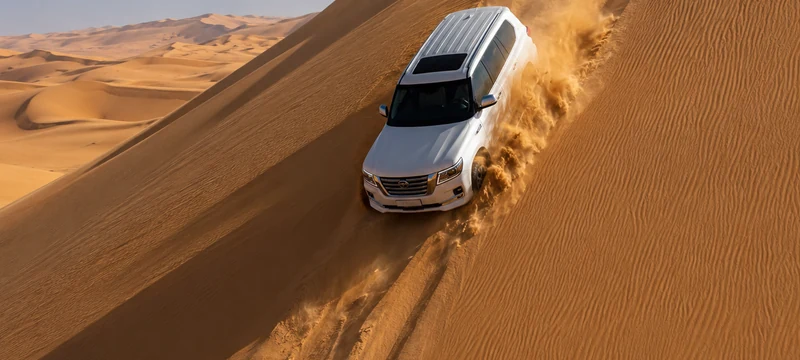
Dune bashing is off road driving purpose built for sand dunes, in a 4x4 vehicle, up, down and across the shifting terrain rather than on a fixed track. It is one of the signature desert activities across the Gulf, and Liwa is one of the more serious places to try it, thanks to genuinely large dunes rather than the smaller sand hills closer to the cities.
The activity depends far more on the driver than the vehicle. Soft sand behaves unpredictably, a 4x4 badge alone does not guarantee traction, and getting stuck is a real and fairly common outcome for anyone without proper technique. That is the whole reason dune bashing is normally sold as a guided experience rather than something people simply try themselves in a rented 4x4.
Liwa sits on the edge of the Rub' al Khali, the Empty Quarter, home to some of the tallest dunes on earth. Tel Moreeb itself rises around 300 metres with a slipface angle of roughly 50 degrees, stretching about 1,600 metres in length, making it the tallest dune in the UAE and one of the most serious hill climbs in the world. That scale is the real difference between dune bashing in Liwa and a shorter session on the smaller dunes closer to Abu Dhabi or Dubai, the terrain here genuinely demands more from both the driver and the vehicle.
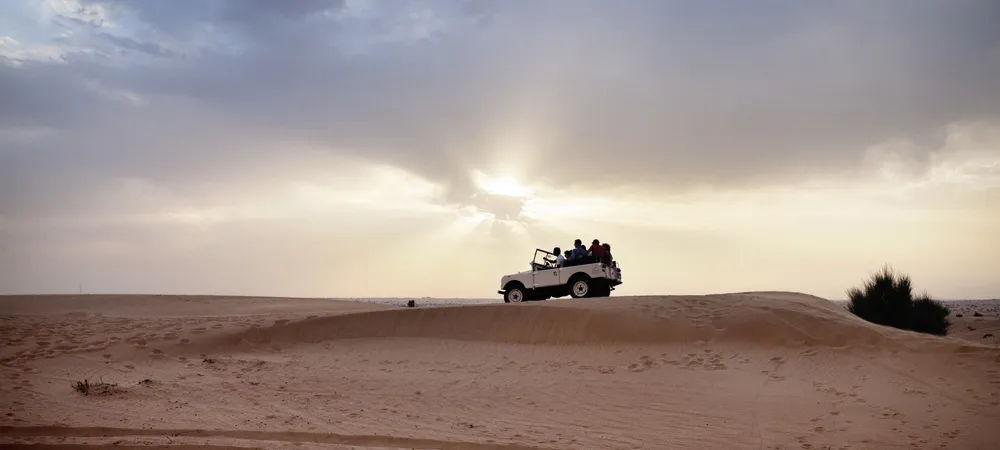
Done with an experienced guide and a properly prepared vehicle, dune bashing in Liwa is a safe, well established tourist activity. The risk comes almost entirely from underestimating the sand. Soft dune faces can shift and give way in ways that firm ground never does, and a vehicle that gets stuck deep in the Empty Quarter, far from a road, is a genuinely different problem to solve than a stuck car on a track near the city.
Why the driver matters more than the vehicle: speed and steering technique have to change constantly with the sand's texture and the slope of the dune, something only comes with real experience reading the terrain. A capable 4x4 in inexperienced hands is still a vehicle that can get stuck, or worse, roll.
This is why booking with professional dune driving tours in Liwa is worth taking seriously rather than treating as an upsell, an experienced guide reads the dune ahead, adjusts speed and line accordingly, and knows the specific route well enough to know where the sand is genuinely soft.
Expect the vehicle to lean and tilt as it climbs and descends dune faces, with sudden dips and rises that earn the "rollercoaster of the desert" comparison people reach for. Speed varies constantly, sometimes accelerating hard to keep momentum up a steep face, sometimes slowing right down on a soft descent, all controlled by the driver rather than a fixed pace. It is a genuinely physical sensation, not just a scenic drive, expect a real adrenaline response even from the passenger seat.
Dune bashing is not a standalone booking on its own, it comes built into several different Liwa tours depending on how you want the rest of your day or trip to look:
Guided dune bashing as part of a full day out, alongside the Liwa Oasis, Moreeb Dune and a camel farm stop.
For guests who want to be behind the wheel themselves, 15 to 25 minutes on Tel Moreeb after instruction, under a guide's supervision throughout.
See the Self Drive Adventure →
Dune bashing built into a full overnight stay in the Empty Quarter, for the version that ends with a night under the stars rather than a drive home.
Tell us how you want your day to look, guided and relaxed, self drive with instruction, or a full overnight in the dunes, and we'll point you to the right tour.
Yes, with an experienced guide and a properly prepared, insured 4x4. The genuine risk comes from underestimating soft sand and steep dune faces, which is why it is normally done as a guided activity rather than self driving into large dunes without training.
No, not for a guided tour, the guide does the driving and handles the technique. Self drive options exist too, but those include instruction and supervision first rather than handing over the wheel with no preparation.
It is genuinely thrilling, with real tilting, dipping and sudden changes of speed, which some people find intense. With an experienced driver and a properly maintained vehicle it is a well established, safe tourist activity, the sensation is designed to feel more dramatic than the actual risk.
Loose, secure clothing and closed shoes rather than beach wear, sand gets into the vehicle and onto you during an active session. Sunglasses and a light scarf are worth having too.
Late afternoon, when low sun angles bring out the gold and red tones the dunes are known for. Midday light tends to flatten the colour and contrast that make Liwa's dunes so photogenic.