


 Destination
 Verified
Every line on the official dress code reduces to these three, plus two habits that keep you out of trouble.
Sleeves for everyone. No vests, no sleeveless tops, no off-the-shoulder.
Trousers or a skirt to the ankle. No shorts, no short skirts, no slits.
Women cover all their hair with any scarf. Men do not.
Loose: leggings, skinny jeans and bodycon dresses are refused even when everything is covered. Plain: no see-through fabric, no slogans, no skulls, no heavy make-up or statement jewellery.
That is the rule. The sections below only answer the follow-up questions people ask about their own wardrobe.
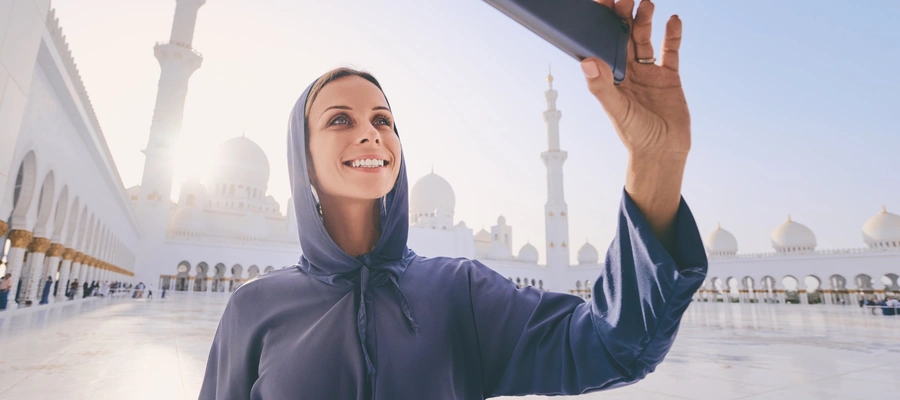
Loose clothing to the ankle and the wrist, a scarf covering all the hair, nothing tight or transparent. No abaya is needed; your own clothes are fine if they meet those three conditions.
| Passes every time | Stopped at security |
|---|---|
| Wide or straight trousers with a long-sleeved top | Leggings, jeggings, skinny jeans |
| Maxi skirt or maxi dress with sleeves | Dress or skirt with a slit, or above the ankle |
| Loose jeans with a tunic or shirt | Bodycon or fitted dress, even floor length |
| Any scarf that covers all the hair and neck | Cap, hood, headband or small scarf with hair showing |
| Light cotton or linen layers | Sheer, lace or mesh fabric over bare skin |
| Plain colours, light jewellery | Slogans, prints with faces or skulls, heavy make-up |
The scarf does not have to be a hijab or a shayla. A pashmina, a large cotton scarf or the one you used on the flight all pass. Wrap it before you reach the security lane. Three-quarter sleeves are usually tolerated but wrist-length is the published rule, so a light cardigan in your bag removes the doubt.
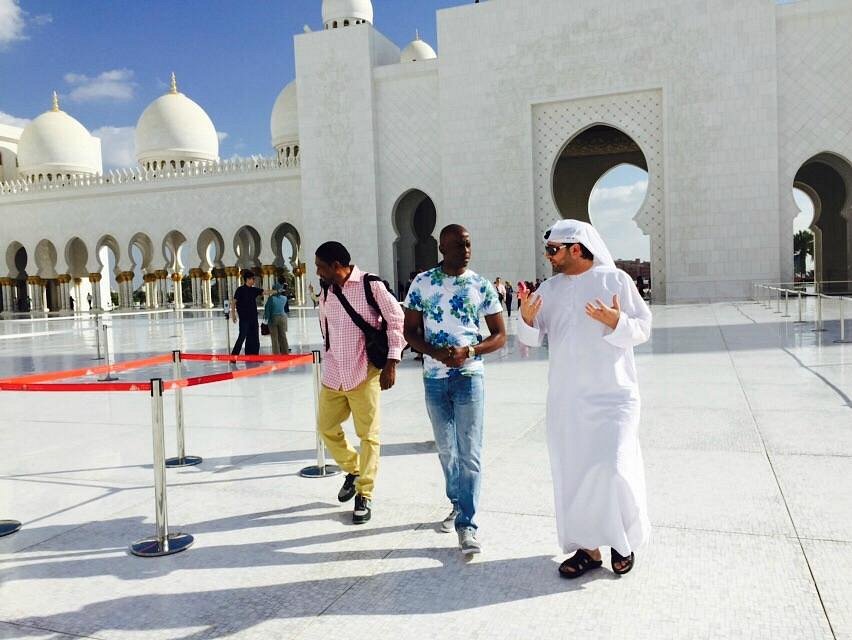
Long trousers and a shirt with sleeves. Shorts are the single most common reason a man is refused, and knee-length or three-quarter shorts count as shorts.
Children follow the same rule: shoulders and knees covered, loose and plain. Girls under about ten are generally not asked to cover their hair, though staff apply this with discretion, so pack a small scarf for girls of school age and avoid the argument at the gate. Babies and toddlers in ordinary clothing are not an issue. Note that dolls and stuffed animals cannot be carried in, which catches out families more often than clothing does.
Yes
Loose or straight jeans, for women and men
No
Skinny jeans, jeggings, ripped jeans
Yes
Maxi skirt or maxi dress with sleeves
No
Shorts of any length, for anyone
Yes
Short sleeves for men, long sleeves for women
No
Leggings or yoga pants, even under a long top
Yes
Sandals, trainers, any shoe you can slip off
No
Sleeveless tops or vests, for anyone
Yes
Any scarf that covers all of a woman's hair
No
Sheer, mesh or lace over bare skin
Yes
Plain T-shirts and light jewellery
No
Skulls, slogans, heavy make-up, flags or symbols
Shoes come off before the prayer hall and go on the racks provided, so anything easy to remove saves time. Socks are optional; the marble is cool in winter and hot at midday in summer.
This is the board the security team at Al Noor entrance checks you against. If your outfit matches the top row, you are in.
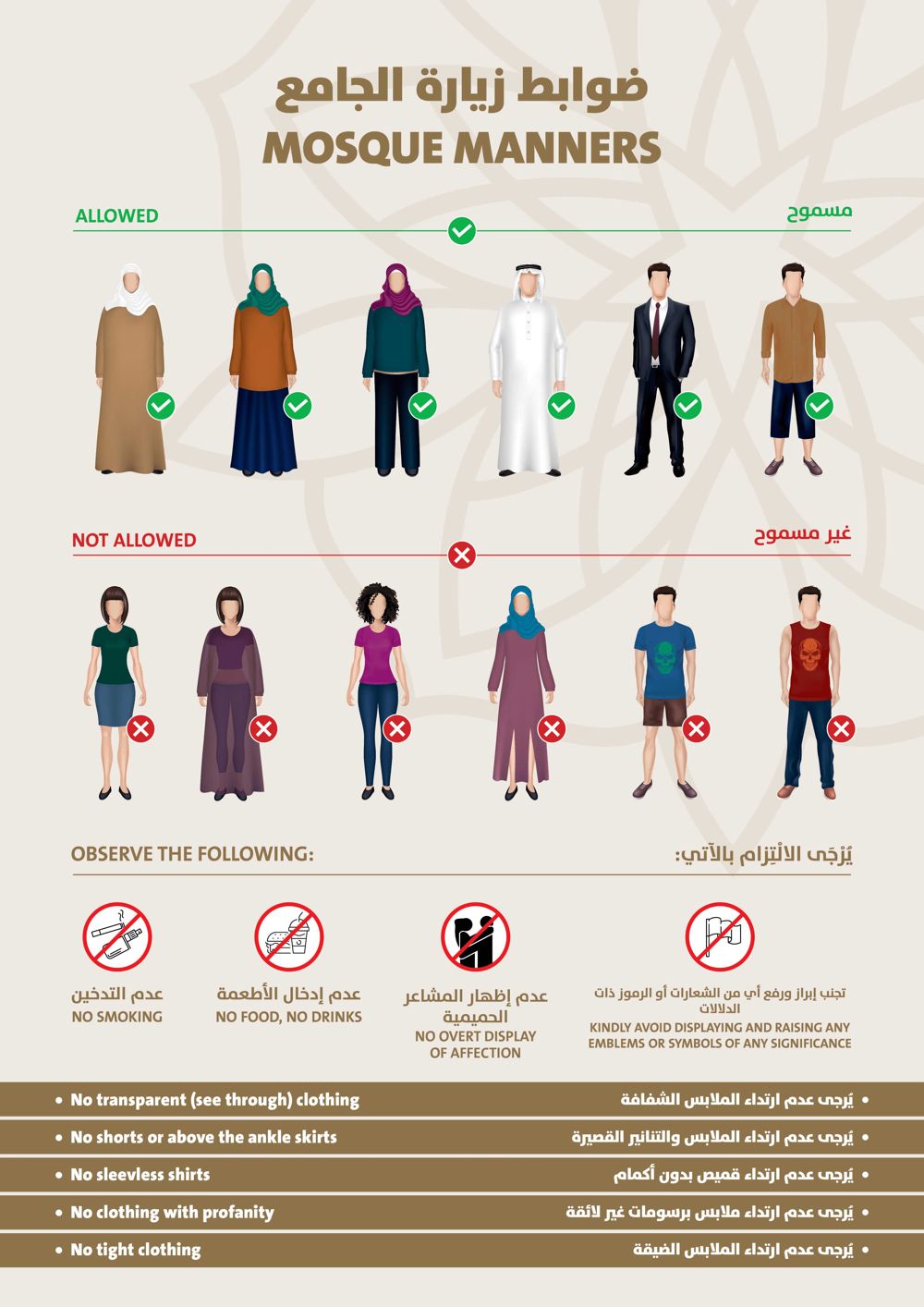
Source: Sheikh Zayed Grand Mosque Centre, Mosque Manners.
Two of the six "not allowed" figures are the ones that surprise visitors: the woman in a long dress with a slit, and the woman in a headscarf and jeans that are tight. Both are covered from neck to ankle and both are refused. Loose is not optional.
Security checks every visitor at the entrance, separately for women and men. Fail the check and you cannot enter until you fix it. The old advice that the mosque lends you an abaya no longer holds: the Centre stopped lending to anyone arriving with a tour operator in October 2019 and made operators responsible for their guests' attire. Independent visitors are sometimes offered a cover-up if one is available, but you cannot plan on it.
The fallback is the shops in Souq Al Jami' under the mosque, where a plain abaya or scarf should be about AED 45. Ask the price before it is wrapped; one visitor in July 2026 was first shown a garment close to AED 1,000. Buying is better than renting because you will use it again at Qasr Al Watan and in Dubai's old town.
On Arabiers tours the check is done before you leave the hotel. The Abu Dhabi city tour with the Grand Mosque carries abayas and scarves in the vehicle, and the guide walks you to the correct lane so nobody is standing at the entrance in the wrong outfit after the drive from Dubai.
Loose beats tight for the heat as well as for the rule. Wide linen or cotton trousers, a long loose shirt and a light scarf are cooler than anything fitted, and the white marble reflects the sun upwards, so covered skin is more comfortable than bare skin at midday. Between May and September visit at 9am or after 6pm, wear sandals you can slip off, and finish your water before security because it cannot come inside.
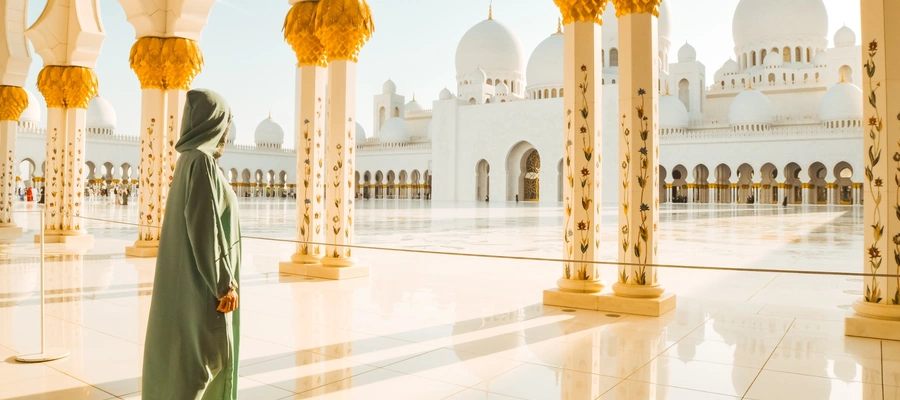
For photos, the same outfit that got you in is the one you keep on. Do not remove the scarf for a picture, do not lie on the marble, and use the designated photo stops; staff will move you on from anywhere else. Light colours photograph well against the white stone; the courtyard at sunset is the shot everyone wants, and the timing for it is in our Grand Mosque timings guide.
Visiting hours, the entry fee and the route from the car park are covered in the timings and opening hours guide.
Sources: SZGMC Mosque Manners and visitor code of conduct; SZGMC FAQs; Arabiers guide field notes, September 2026.
Cover your shoulders, your knees and, for women, your hair. Clothing should be loose and plain: no transparent, tight, sleeveless or slogan clothing, no shorts, no skirts above the ankle. Long trousers and a long-sleeved top with a headscarf for women, and long trousers with a sleeved shirt for men, pass every time. The rule applies to every visitor of every faith, and to children.
Yes. Women need loose clothing that reaches the ankles and the wrists, a scarf covering all the hair, and nothing transparent, tight or revealing. Any long loose dress, wide trousers with a long tunic, or a maxi skirt with a long-sleeved top works. Leggings, skinny jeans, bodycon dresses and dresses with slits are refused even when everything is technically covered.
Women do, from the moment they pass security until they leave. Any scarf that covers all the hair is acceptable; it does not have to be a hijab or an abaya, and the lightweight scarf from your flight is fine. Men do not cover their heads.
Any scarf large enough to cover all the hair and the neck. A pashmina, a large cotton scarf or a shayla all pass. A cap, a hood, a headband or a small scarf that leaves hair showing does not. Wrap it before you reach the security lane so you are not adjusting it in the queue.
Long trousers and a shirt with sleeves. Shorts are refused, including knee-length and three-quarter shorts, and so are vests, sleeveless shirts and anything transparent or tight. T-shirts with plain designs are fine; skull prints, slogans and offensive images are not. A kandura is welcome but not expected.
Children follow the same rule as adults: shoulders and knees covered, loose and plain. Girls under about ten are generally not asked to cover their hair, though staff apply this with discretion, so pack a small scarf for girls of school age. Babies and toddlers in ordinary clothing are not an issue.
Yes, if they are loose. Straight, relaxed or wide-leg jeans with a long-sleeved top pass every time. Skinny jeans, jeggings and ripped jeans are turned away, because the rule is about the shape of the garment and what it shows, not the fabric.
No, for anyone. Shorts, three-quarter trousers, short skirts and anything that ends above the ankle are refused at security. Bring a pair of long trousers or a long skirt; the mosque no longer lends cover-ups to tour groups, and the shops under the mosque are not cheap.
Anything easy to remove. Shoes come off before the prayer hall and go on the racks provided, so slip-ons, sandals and trainers without complicated laces save time. Sandals and open shoes are fine for both men and women. Bring socks if you would rather not walk barefoot on the marble; in summer it is hot underfoot at midday.
Strict and consistent. Security staff check every visitor at the Al Noor entrance against illustrated boards showing what passes and what does not, and they refuse tight or transparent clothing even when it covers everything. Rihanna was asked to leave in 2013 for a tight outfit and posing for photos; the boards went up soon after. Dressing correctly is the only reliable way in.
You are stopped at security and cannot enter until you fix it. Individual visitors are sometimes offered a cover-up if one is available, but the Centre stopped lending abayas to tour-group visitors in October 2019, so do not count on one. The practical fix is a shop in Souq Al Jami' below the mosque, where a plain abaya or scarf is around AED 45 if you ask the price first.
Not reliably. The mosque withdrew abaya lending for anyone arriving with a tour operator in October 2019 and made operators responsible for their guests' attire. Independent visitors may be offered something if stock is available, but the safe assumption is no. On Arabiers tours the abaya and scarf are in the vehicle before pick-up.
Buy rather than rent. The shops in Souq Al Jami' under the mosque sell abayas and scarves, and a plain abaya should be about AED 45; one visitor in July 2026 was first shown a garment close to AED 1,000, so ask the price before it is wrapped. Any mall in Abu Dhabi or Dubai sells long loose dresses and scarves for less. Most guests need nothing new: loose trousers, a long-sleeved top and a scarf from home cover it.
Your own clothing is enough. No abaya, kandura or traditional dress is required for anyone. Loose trousers or a long skirt, a long-sleeved top and a scarf for women meet the rule in full. Special attire only comes into it if what you arrive in fails the check.
Loose and light. Wide linen or cotton trousers, a long loose shirt and a light scarf are cooler than anything fitted, and the mosque's white marble reflects heat upwards, so covered skin is more comfortable than bare skin at midday. Visit at 9am or after 6pm between May and September, wear sandals you can slip off, and carry water for the car park walk; it cannot come inside.
Yes. Photos are welcome at the designated photo stops for personal use, in the same clothing that got you through the door: no removing the scarf for a picture, no lying on the marble, no posing that staff would read as disrespectful, and no photographing worshippers. Professional equipment and commercial shoots need a permit from the Centre.
Visitors are not asked and no such condition applies to sightseeing entry. The mosque's visitor rules cover dress and behaviour only. Worshippers follow their own religious practice, which is a personal matter the Centre does not police.
No food or drink past security, including water; no smoking or e-cigarettes anywhere on the grounds; shoes off before the prayer hall; phones on silent; no public displays of affection; no dolls, stuffed animals, flags, banners or masks; photos only at the designated stops. Full visiting hours, the entry fee and how to get from the car park to the entrance are in our Grand Mosque timings guide.